Affiliate Disclosure: This article may contain affiliate links. If you purchase through these links, Pickleball Sport may earn a small commission at no additional cost to you. As an Amazon Associate, I earn from qualifying purchases.
Read our full Affiliate Disclosure.
New to pickleball? Our Pickleball Tips for Beginners: 10 Easy Ways to Improve Your Game guide covers essential rules, serving techniques, and court positioning to help you build confidence before your next match.
You’ve probably heard someone shout, “Stay out of the kitchen!” during a pickleball game. Maybe you’ve even been told you can’t step inside that area near the net.
But here’s something that surprises many beginners: you’re actually allowed to stand in the kitchen.
The real restriction is about hitting the ball before it bounces.
Understanding pickleball kitchen rules is essential because a simple foot-placement mistake can cost you a rally—even when you’ve hit a winning shot.
In this guide, we’ll explain exactly what the kitchen is, when you can enter it, which shots are legal, and how to avoid the most common non-volley-zone mistakes.
By the end, you’ll feel more confident moving around the net and making smarter decisions during rallies.
Quick Takeaways: Pickleball Kitchen Rules
- The kitchen is the seven-foot non-volley zone on each side of the net.
- You can step into the kitchen whenever you’re not performing a volley.
- You cannot volley while touching the kitchen or its boundary line.
- A volley is a shot hit before the ball bounces.
- You can enter the kitchen to return a ball after it bounces.
- Your momentum cannot carry you into the kitchen after a volley.
- If you’ve entered the kitchen, both feet must reestablish contact completely outside it before you can volley again.
1. What Is the Kitchen in Pickleball?
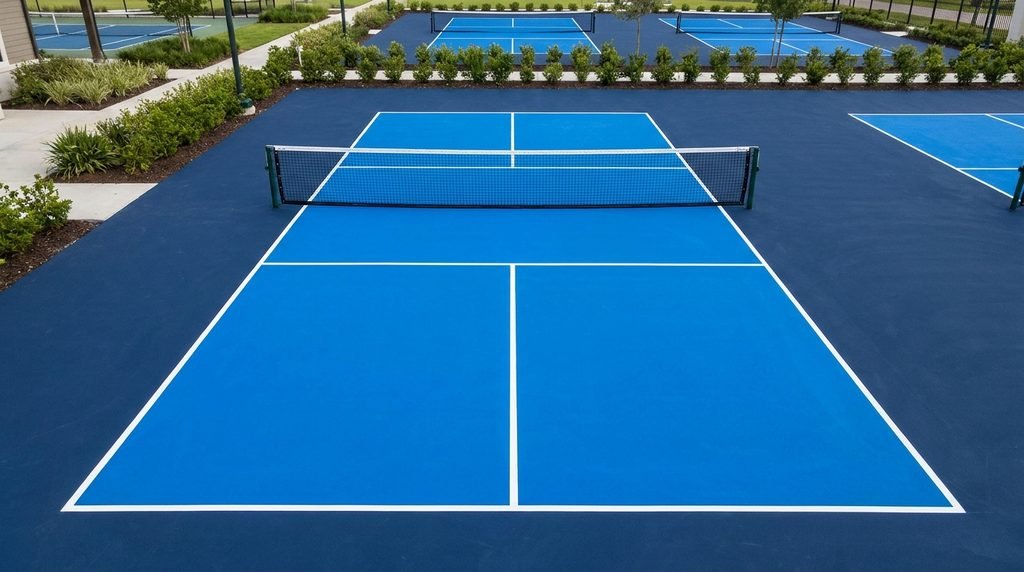
The kitchen is the area immediately next to the net on each side of a pickleball court.
Its official name is the non-volley zone, often abbreviated NVZ.
It extends seven feet from the net toward each baseline and covers the entire 20-foot width of the court.
The kitchen includes its boundary lines, which means the line separating the kitchen from the rest of the court is considered part of the non-volley zone.
Why Is It Called the Kitchen?
“Kitchen” is the popular nickname used by pickleball players.
The official rules call it the non-volley zone because it restricts players from volleying while touching that area.
A volley means hitting the ball out of the air before it bounces.
The zone helps prevent players from dominating every rally with powerful volleys right beside the net.
What Does the Kitchen Look Like?
Imagine a rectangular strip extending seven feet back from the net on your side of the court.
Your opponents have an identical strip on their side.
Those two areas are the kitchens.
Beginner tip: Look for the horizontal line seven feet from the net. This is the non-volley-zone line, commonly called the kitchen line.
2. Pickleball Kitchen Rules: The Seven Essentials
There are seven important principles every beginner should understand.
Rule 1: You Cannot Volley While Touching the Kitchen
If you hit a ball before it bounces, you must not be touching the non-volley zone.
That includes standing with a foot on the kitchen boundary line.
Even touching the line with part of your shoe during a volley results in a fault.
Rule 2: You Can Enter the Kitchen to Hit a Bounced Ball
This is one of the most misunderstood rules.
If the ball bounces inside the kitchen, you’re allowed to step in and return it.
You can also stand there while waiting, provided you don’t volley.
Rule 3: The Kitchen Line Counts as Part of the Kitchen
The kitchen boundary line isn’t neutral territory.
If your foot touches it while you’re volleying, it’s a fault.
Give yourself a small margin behind the line when preparing for volleys.
Rule 4: Your Momentum Cannot Carry You Into the Kitchen After a Volley
Suppose you strike a volley while standing legally outside the kitchen.
Your shot clears the net and your opponents cannot return it.
But your forward momentum then carries you onto the kitchen line.
That’s still a fault.
The restriction applies even if the ball has already become dead.
Rule 5: Both Feet Must Be Reestablished Outside Before Volleying
If you’ve stepped into the kitchen, you must get both feet completely outside the zone before volleying again.
You cannot simply jump from inside the kitchen and hit the ball while airborne.
First, reestablish both feet on the playing surface outside the non-volley zone.
Rule 6: Your Clothing, Paddle, or Partner Can Cause a Kitchen Fault
Kitchen faults aren’t limited to your shoes.
During a volley, contact involving something you’re wearing or carrying can also create a fault.
For example, a dropped paddle touching the kitchen during the volleying action can result in a violation.
You can also commit a fault if your volleying momentum carries you into a partner who is touching the kitchen.
Rule 7: You Can Reach Over the Kitchen Without Stepping Into It
The non-volley zone is defined by the playing surface, not an imaginary wall extending upward.
You can legally volley a ball while reaching over the kitchen, provided you and anything relevant to the volleying action don’t contact the zone and your momentum doesn’t carry you into it.
Remember: The kitchen rule is about prohibited contact during a volley, not simply where the ball is located.
3. When Can You Step Into the Kitchen?
You can enter the kitchen at any time when you’re not performing a volley.
For beginners, the most common reason is to return a soft shot that has bounced near the net.
Example: A Legal Kitchen Shot
Your opponent hits a gentle dink.
The ball crosses the net and bounces inside your kitchen.
You step forward, allow the bounce, and softly return the ball.
That’s a legal shot.
You don’t have to remain behind the kitchen line to hit a ball after it bounces.
Can You Stand in the Kitchen During a Rally?
Yes.
Standing inside the kitchen isn’t automatically a fault.
However, because you cannot volley from there, remaining inside can limit your ability to respond to fast shots.
That’s why many players prefer a balanced position just behind the kitchen line.
Can Both Players Stand in the Kitchen?
Yes, but neither player can legally volley while touching the zone.
In doubles, each player must independently follow the non-volley-zone rules.
4. What Happens If You Step on the Kitchen Line?
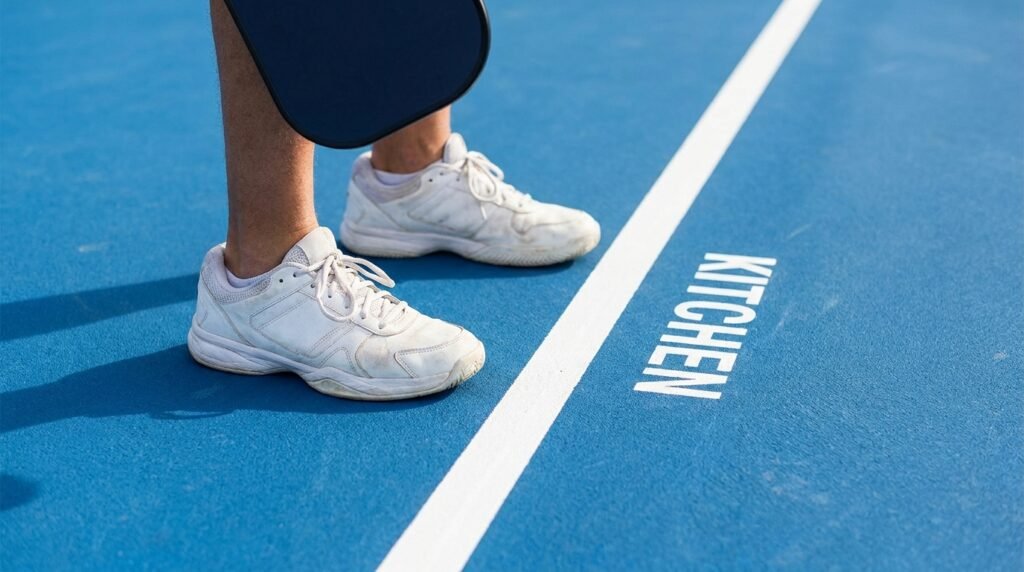
The kitchen line is considered part of the non-volley zone.
Whether touching it causes a fault depends on what you’re doing.
| Situation | Legal or fault? |
|---|---|
| Standing on the kitchen line without volleying | Legal |
| Hitting a ball after it bounces while on the line | Legal |
| Volleying while your toe touches the line | Fault |
| Volleying from behind the line and staying balanced outside | Legal |
| Volleying outside, then stepping onto the line because of momentum | Fault |
| Entering the kitchen, exiting completely, then volleying after both feet are reestablished outside | Legal |
Beginner tip: When expecting a volley, stand a comfortable distance behind the kitchen line rather than balancing directly on it.
5. What Is the Kitchen Momentum Rule?
The momentum rule is one of the easiest restrictions for new players to overlook.
Imagine you’re standing just behind the kitchen line.
Your opponent hits a high ball, and you strike a strong volley.
The ball lands in the opponent’s court, and the rally appears to be over.
But your forward movement causes you to stumble into the kitchen.
Under the rules, you’ve committed a fault because your volleying momentum carried you into the non-volley zone.
For the official wording on kitchen faults and momentum violations, review USA Pickleball’s current rulebook and rules resources.
When Does Momentum End?
The important question is whether you’ve regained balance and control of your movement.
If your momentum from the volley carries you into the kitchen, the violation still applies even when the ball is no longer in play.
How to Avoid Momentum Faults
- Avoid lunging forward unnecessarily.
- Maintain a balanced stance.
- Use controlled paddle movements.
- Position yourself slightly behind the line when needed.
- Practice stopping your forward movement after volleys.
You don’t have to hit every ball aggressively to be effective.
Often, a controlled shot gives you a better chance of remaining balanced.
6. What Is a Dink, and Why Is It Important Near the Kitchen?
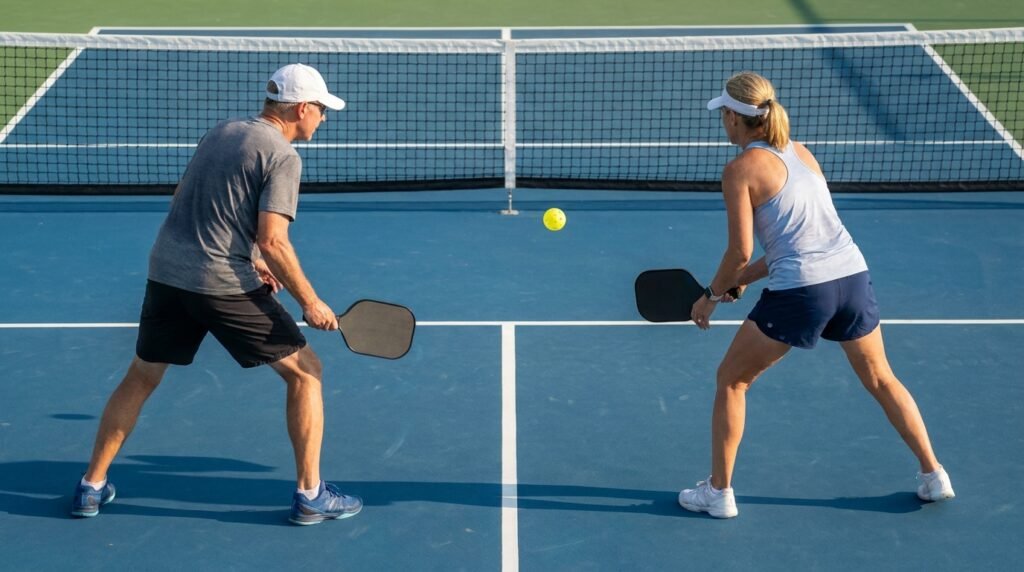
A dink is a soft pickleball shot, usually played from near the kitchen line, that arcs over the net and lands in the opponent’s kitchen.
Dinking is a useful skill because it encourages patience, accuracy, and ball control.
Instead of hitting the ball hard, you’re attempting to make your opponent return another controlled shot.
How to Practice a Basic Dink
- Stand just behind your kitchen line.
- Ask a partner to stand opposite you near their kitchen line.
- Gently send a ball over the net.
- Aim to have it land inside your partner’s kitchen.
- Let the ball bounce before returning your partner’s dink.
- Try to complete five consecutive soft shots.
You can gradually increase the target to 10 or 15 successful shots.
Why Beginners Should Practice Dinks
Dinks help players learn to control pace and placement.
They also encourage better balance and shorter, more controlled paddle movements.
For additional exercises, see our 7 Easy Pickleball Drills for Beginners to Improve Faster article.
7. Common Kitchen Mistakes Beginners Make
Understanding the rules is important, but applying them during a fast rally takes practice.
Here are several mistakes to watch for.
Mistake 1: Believing You Can Never Enter the Kitchen
You can legally enter the kitchen to return a bounced ball.
The restriction is on volleying while touching the zone.
Mistake 2: Volleying With a Toe on the Line
The non-volley zone line counts as part of the kitchen.
Even partial contact while volleying is a fault.
Mistake 3: Falling Forward After a Volley
A player may make a legal volley initially but commit a fault when the resulting momentum carries them into the kitchen.
Practice maintaining balance after contact.
Mistake 4: Jumping Out of the Kitchen to Volley
If you’ve been inside the kitchen, you must reestablish both feet completely outside it before volleying.
Jumping from the kitchen and hitting a volley before landing outside doesn’t satisfy this requirement.
Mistake 5: Standing Too Close to the Line
Standing directly on the kitchen line leaves little room for error during a volley.
Position yourself comfortably behind it.
Mistake 6: Confusing the Kitchen Rule With the Two-Bounce Rule
The two-bounce rule applies to the opening shots of a rally.
The kitchen rule controls volleying in the non-volley zone throughout the rally.
These are separate requirements.
Our 10 Common Pickleball Mistakes Beginners Make guide explains additional errors and how to correct them.
8. Three Easy Kitchen Drills for Beginners
You don’t need specialized training equipment to practice kitchen positioning.
A comfortable paddle, suitable pickleballs, and access to a court are enough.
Drill 1: Kitchen Line Awareness
Stand behind the kitchen line.
Make a few gentle simulated volleys while keeping your feet completely outside the zone.
Pause after each movement and check your position.
Goal: Develop awareness of the kitchen boundary.
Drill 2: Step In, Return, Step Out
Ask a partner to feed gentle balls that bounce inside your kitchen.
Step forward, allow the bounce, and return the ball.
Then move back behind the kitchen line, regaining balance before attempting any volley.
Goal: Learn to transition between bounced shots and volley-ready positioning.
Drill 3: Controlled Dink Rally
Stand opposite your partner near the kitchen line.
Exchange soft shots that bounce in the kitchen.
Aim for five consecutive successful dinks.
Gradually increase the number as your consistency improves.
Goal: Develop soft touch, patience, and controlled movement.
9. Kitchen Rules vs. the Two-Bounce Rule
These two rules are often confused because both involve hitting a ball before or after it bounces.
However, they serve different purposes.
| Rule | What it controls |
|---|---|
| Kitchen rule | Whether a player may volley while touching the non-volley zone |
| Two-bounce rule | The requirement that the serve and return of serve each bounce before volleys are allowed |
For example, after both required bounces have occurred, you may volley a later shot—but only if you follow the kitchen restrictions.
For official explanations, consult the USA Pickleball Rules Summary.
Frequently Asked Questions About Pickleball Kitchen Rules
Can you step into the kitchen in pickleball?
Yes. You’re allowed to enter the kitchen when you’re not performing a volley.
You can step in to return a ball after it bounces.
Can you hit the ball while standing in the kitchen?
Yes, if the ball has bounced before you hit it.
You cannot volley while touching the kitchen or its boundary line.
Can your paddle enter the kitchen?
Your paddle can extend over the kitchen without a fault.
However, contact with the non-volley zone during a volleying action may create a fault.
Can you jump over the kitchen line?
You must not initiate a volley while touching the kitchen, and your volleying momentum cannot carry you into it.
If you’ve been inside the kitchen, both feet must first reestablish contact completely outside the zone before you volley.
Can you volley while standing behind the kitchen line?
Yes, provided you’re completely outside the zone, and your momentum doesn’t cause prohibited contact afterward.
What happens if your foot touches the kitchen line?
If you’re volleying, contact with the line is a fault.
If you’re playing a ball after it bounces, touching the line is permitted.
Why is the kitchen seven feet long?
The non-volley zone is part of pickleball’s court design and helps prevent players from volleying directly beside the net.
It encourages a combination of controlled shots, positioning, and strategy.
Do kitchen rules apply in singles and doubles?
Yes. The non-volley-zone rules apply to both singles and doubles games. Still learning the rules? Our Pickleball Scoring Explained: A Simple Guide for Beginners article walks you through the 0-0-2 starting score, serving rotations, and how points are awarded in singles and doubles.
Final Thoughts: Learn the Kitchen Rules and Play With Confidence
The kitchen is one of the most distinctive parts of pickleball, but its rules become much easier to understand once you remember one essential point:
You can enter the kitchen, but you cannot volley while touching it.
Keep an eye on your foot position, stay balanced after volleys, and remember that the kitchen line counts as part of the zone.
Practice simple dinks and controlled movement until the correct positioning starts to feel natural.
Understanding pickleball kitchen rules will help you avoid unnecessary faults, enjoy longer rallies, and become more confident near the net.
Ready to practice your kitchen-line skills? Explore our Shop the Gear page for beginner-friendly paddles, pickleballs, and useful court accessories to help you prepare for your next game.