Affiliate Disclosure: This article may contain affiliate links. If you purchase through these links, Pickleball Sport may earn a small commission at no additional cost to you. As an Amazon Associate, I earn from qualifying purchases.
Read our full Affiliate Disclosure.
New to pickleball? You don’t need an expensive paddle, perfect technique, or years of experience to start enjoying the game. A few simple pickleball tips for beginners can help you understand the rules, avoid common mistakes, and feel more confident every time you step onto the court.
Whether you’re getting ready for your first match or still figuring out what the kitchen and two-bounce rule mean, learning the fundamentals makes a big difference.
Pickleball combines elements of tennis, badminton, and table tennis, but its smaller court and straightforward equipment make it approachable for newcomers. The trick isn’t to hit every ball harder or master every shot immediately. It’s to develop good habits, understand where to stand, and practice the skills that matter most.
In this beginner-friendly guide, we’ll walk through 10 practical tips to help you get started, improve your control, and enjoy the game from your very first serve.
Quick Takeaways: What Every Beginner Should Know
- Learn the basic rules before your first game, especially the two-bounce rule and the kitchen.
- Choose a comfortable paddle and supportive court shoes rather than expensive equipment.
- Focus on accurate serves and returns instead of hitting the ball as hard as possible.
- Keep your knees slightly bent, your paddle ready, and your eyes on the ball.
- Practice consistently, communicate with your partner, and remember to have fun.
1. Learn the Basic Pickleball Rules First
One of the best pickleball tips for beginners is to understand how the game works before worrying about advanced techniques.
Pickleball can be played as singles, with one player on each side, or doubles, with two players per team. Doubles is a popular format at recreational courts and community centers.
A standard pickleball court measures 20 feet wide and 44 feet long, whether you’re playing singles or doubles.
How Does Pickleball Scoring Work?
In traditional pickleball scoring, only the serving team can score a point. Most recreational games are played to 11 points, and you must win by at least two points.
In doubles, both players on a team normally have an opportunity to serve before the serve passes to the opponents. The exception is the beginning of each game, when the starting serving team receives only one server turn.
That’s why the opening score in traditional doubles is 0-0-2.
Some games and tournaments use rally scoring, where the team winning each rally earns a point regardless of who served. For your first few games, ask which scoring system your group is using.
Beginner tip: Don’t worry about memorizing every scoring situation immediately. Learn the basic sequence, listen to experienced players call the score, and ask questions when needed.
2. Understand the Kitchen and Two-Bounce Rule
Two pickleball rules confuse beginners more than almost anything else: the kitchen rule and the two-bounce rule. For official rule explanations and updates, consult the USA Pickleball rulebook.
Fortunately, both become easier to remember once you understand their purpose.
What Is the Kitchen in Pickleball?
The kitchen is the non-volley zone extending seven feet from the net on each side of the court.
You cannot hit the ball out of the air while touching this area or its boundary line. Hitting the ball before it bounces is called a volley.
However, you can step into the kitchen to hit a ball that has already bounced.
You also cannot volley the ball and allow your momentum to carry you into the kitchen afterward.
Beginner tip: Practice stopping just behind the kitchen line before attempting volleys. This helps prevent unnecessary faults and improves your balance.
What Is the Two-Bounce Rule?
Every pickleball rally begins with two required bounces:
- The serve must bounce on the receiving team’s side.
- The return of serve must bounce on the serving team’s side.
- After those two bounces, players may hit the ball out of the air or allow it to bounce before returning it.
This rule encourages longer rallies and prevents players from rushing the net immediately after serving.
Remember: One bounce on each side before anyone volleys.
3. Choose the Right Beginner Pickleball Equipment
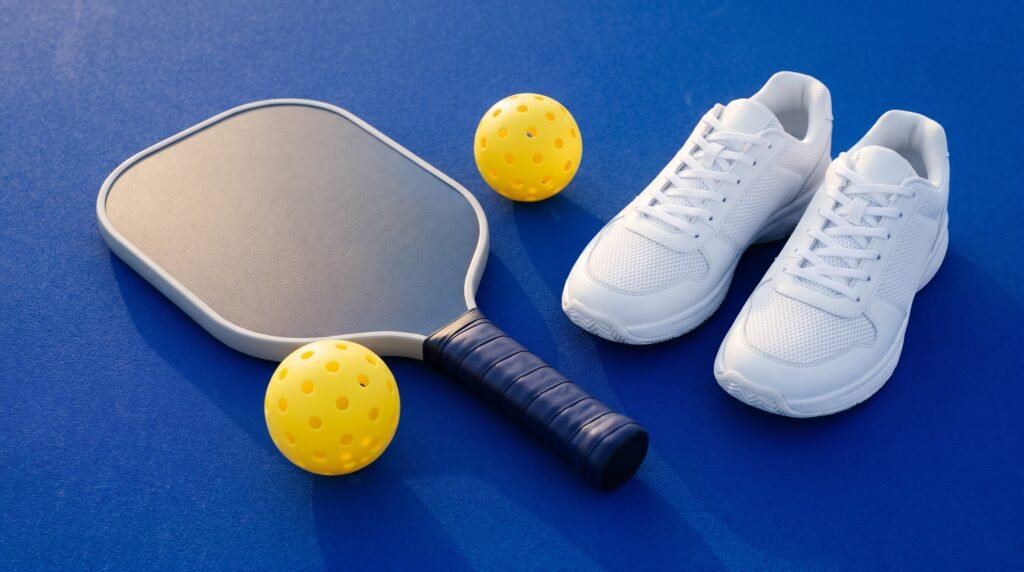
You don’t need a collection of expensive equipment to begin playing pickleball.
Not sure what to bring to your first game? Our beginner pickleball equipment guide explains the essentials and what you can skip
What Equipment Do Beginners Need?
Start with these essentials:
- Pickleball paddle: Choose a comfortable paddle that feels manageable in your hand.
- Pickleball balls: Use balls appropriate for indoor or outdoor play.
- Court shoes: Choose shoes designed for lateral movement and quick stops.
- Comfortable clothing: Wear breathable clothing that allows easy movement.
- Water bottle: Stay hydrated, especially when playing outdoors.
How to Choose Your First Pickleball Paddle
Beginners should pay attention to three important features.
Weight: A paddle that’s comfortable to swing can help you maintain better control. Many beginners prefer a moderate weight rather than an unusually heavy paddle.
Grip size: The handle should fit securely in your hand without forcing you to squeeze too tightly.
Paddle material: Fiberglass and carbon fiber paddles offer different playing characteristics, but beginners don’t need a premium paddle to develop fundamental skills.
Start with a paddle that feels balanced and comfortable. As your game improves, you’ll have a better understanding of which features matter to you.
For a more detailed breakdown, explore our guide to choosing the right pickleball paddle.
Indoor vs. Outdoor Pickleball Balls
Indoor pickleballs typically have larger holes and are designed for indoor playing conditions.
Outdoor balls generally use smaller holes and harder plastic to accommodate outdoor surfaces and conditions.
Choosing the appropriate ball helps make your practice more consistent.
Beginner tip: If you’re attending a community open-play session, ask whether the facility provides paddles and balls before purchasing your own.
4. Warm Up Before You Play
Pickleball may look like a relaxed sport, but it involves quick changes of direction, short sprints, and sudden stops.
A proper warm-up helps prepare your muscles and joints for those movements.
Before stepping onto the court, spend approximately 5–10 minutes gradually increasing your activity.
Try This Simple Beginner Warm-Up
Start with a few minutes of comfortable walking or easy movement. Then add:
- Arm circles to loosen your shoulders.
- Gentle ankle movements.
- Controlled side steps or lateral shuffles.
- Easy hip rotations.
- A few slow practice swings with your paddle.
Keep your movements comfortable, particularly if you’re returning to physical activity after a break.
Practice Your Ready Position
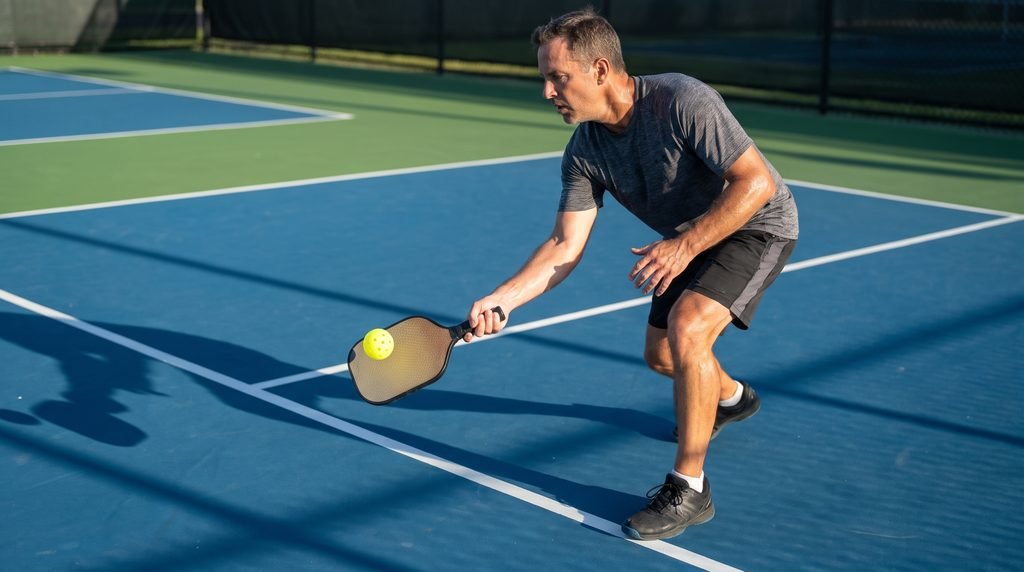
Your ready position helps you react quickly when the ball comes toward you.
Stand with your feet approximately shoulder-width apart, bend your knees slightly, and keep your weight balanced.
Hold your paddle in front of your body rather than letting it hang at your side.
After hitting a shot, return to this position so you’re prepared for the next ball.
Beginner tip: Good positioning often matters more than speed. A balanced player can react more effectively than someone constantly reaching for the ball.
5. Master a Consistent Pickleball Serve
A reliable serve is one of the most valuable skills a beginner can develop.
The goal of your serve isn’t necessarily to hit a winner. It’s to start the rally with a legal, controlled shot.
In pickleball, the serve travels diagonally across the net and must land inside the opposite service court, beyond the kitchen.
How to Serve in Pickleball
There are two common serving methods.
Volley serve: Hit the ball out of the air using a legal upward serving motion. The paddle and contact position must follow the applicable serving rules.
Drop serve: Release the ball without throwing it or forcing it downward, allow it to bounce, and then strike it.
Some beginners find the drop serve easier because it allows them to focus on making comfortable contact with the ball.
Improve Your Serve With This Simple Drill
Choose a large target area near the middle or deeper portion of the opposite service court.
Practice serving 10 balls while concentrating on smooth contact and accuracy.
Count how many legal serves land inside your target area.
Once you’re comfortable, gradually work on placing the ball deeper in the court.
Beginner tip: A consistent serve that lands in is more useful than a powerful serve that regularly goes out.
6. Focus on Ball Control Instead of Power
Many new players assume they need to hit the ball hard to win rallies.
But one of the most important beginner pickleball tips is learning to control the ball before trying to generate more power.
A well-placed shot can force your opponent to move, give you time to recover, and keep you in the rally.
How to Improve Your Ball Control
Start by practicing smooth, controlled swings.
Avoid gripping your paddle so tightly that your wrist and arm become stiff.
Instead, use a comfortable grip that lets you guide the ball toward your target.
When returning a serve, try sending the ball deep into your opponent’s court. This gives you more time to move into a favorable position.
Rather than aiming for the sidelines immediately, choose a larger target comfortably inside the court. Choose a larger target comfortably inside the court.
Try the 10-Shot Challenge
Find a practice partner and attempt to exchange 10 controlled shots without making an error.
Don’t worry about speed.
Focus on smooth contact, comfortable positioning, and keeping the ball in play.
As you improve, increase your target to 15 or 20 consecutive shots.
Beginner tip: Consistency creates opportunities. You don’t need to hit spectacular shots to become a more effective player.
7. Practice Dinks, Returns, and Simple Shots
Once you’re comfortable with serving and returning, begin learning the basic shots you’ll use throughout a pickleball game.
Understanding when to use each shot can make your play more confident and purposeful.
Four Important Pickleball Shots
| Shot | What it does | Beginner goal |
|---|---|---|
| Serve | Starts the rally | Land the ball consistently in the correct service court |
| Return | Sends the serve back | Aim deep and give yourself time to move |
| Dink | Softly sends the ball over the net into the opponent’s kitchen | Develop touch and control |
| Volley | Hits the ball before it bounces | Stay balanced and avoid kitchen faults |
As you progress, you’ll also learn drop shots and drives.
A drop shot is a controlled shot from farther back that aims to land softly near the opponent’s kitchen.
A drive is a firmer groundstroke that sends the ball with greater pace.
How to Practice Dinking
Stand near the kitchen line with a partner.
Gently exchange shots that travel just over the net and land in the opposite kitchen.
Concentrate on keeping your paddle movement short and controlled.
Try to complete five consecutive dinks before increasing the challenge.
Beginner tip: Don’t rush to learn every advanced shot. Strong serves, accurate returns, and controlled dinks provide a useful foundation.
8. Improve Your Footwork and Court Position
Learning where to stand can improve your game just as much as learning how to swing.
Beginners often make the mistake of watching their shots instead of preparing for the next one.
After hitting the ball, return to a balanced ready position and pay attention to your opponent’s movements.
Learn When to Move Toward the Kitchen Line
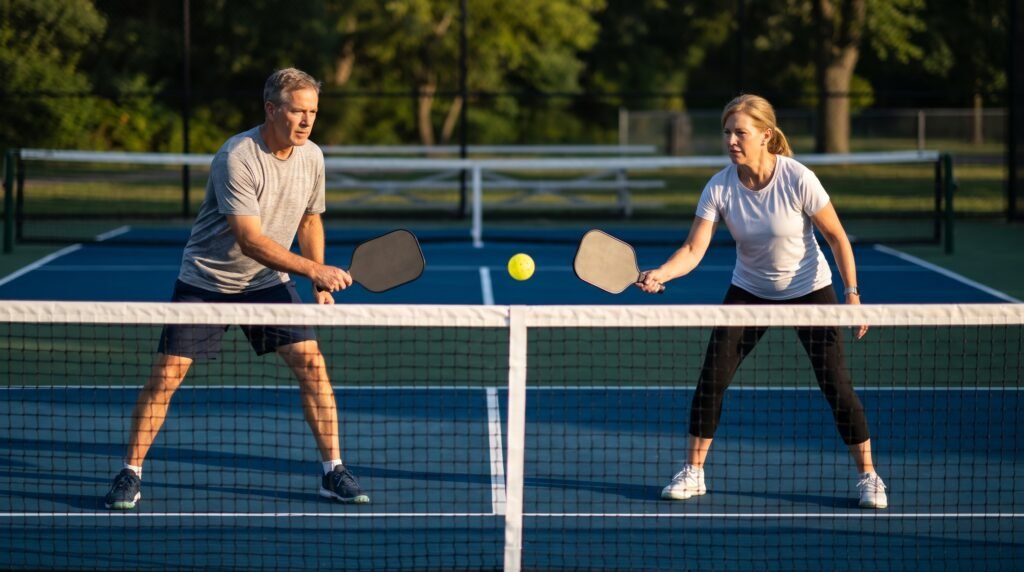
In doubles, a strong position is often near the non-volley zone line, where players can respond to short shots and volleys.
However, you shouldn’t rush forward without considering the two-bounce rule.
When receiving a serve, return the ball and move toward the kitchen line when you can do so safely.
When serving, remember that the return must bounce before your team can hit it. Stay prepared to play that bounce rather than charging forward immediately.
Practice Simple Footwork
Try these movements during a short practice session:
- Side-step to the left and return to center.
- Side-step to the right and return to center.
- Move forward a few steps and stop under control.
- Practice returning to your ready position after a simulated shot.
Take small, balanced steps instead of reaching too far for the ball.
Beginner tip: Try to arrive in position before swinging. Hitting while off balance often creates unnecessary mistakes.
9. Communicate With Your Doubles Partner
If you’re playing doubles, teamwork is just as important as individual technique.
Both players share responsibility for covering the court and keeping rallies alive.
One common beginner mistake is allowing a large opening to develop between partners.
Another is having both players chase the same ball.
How to Play Better Doubles
Communicate clearly with short calls such as “mine,” “yours,” or “out.”
Move laterally with your partner as the ball shifts across the court.
When one player moves toward a sideline, the other should adjust position to help cover the open court.
Avoid standing so close together that you interfere with each other’s swings.
Should Both Partners Stand Near the Kitchen?
When possible, doubles partners generally benefit from moving toward the kitchen line together.
However, the timing depends on the rally.
If one player is pulled back or off balance, the other may need to adjust temporarily.
Focus on maintaining sensible court coverage rather than following a fixed distance between partners.
Beginner tip: Good communication prevents confusion and makes doubles more enjoyable, especially when partners have different experience levels.
10. Practice Regularly and Avoid Common Beginner Mistakes
You don’t have to spend hours on the court every day to improve.
Short, focused practice sessions can help develop reliable skills while keeping the game enjoyable.
For many beginners, practicing two or three times a week is a reasonable starting point, depending on fitness, recovery, and schedule.
Four Easy Pickleball Drills for Beginners
1. Paddle control drill
Gently bounce the ball upward using your paddle.
Try to keep it under control for 10 consecutive touches.
2. Wall rally drill
Use a suitable practice wall and hit controlled shots toward a safe target.
Concentrate on watching the ball and preparing for its return.
3. Serving accuracy drill
Practice 10 serves toward a designated target area.
Count how many land successfully.
4. Partner dink drill
Exchange gentle shots near the kitchen line.
Aim to complete five or more controlled shots without an error.
Five Common Beginner Mistakes to Avoid
- Hitting too hard: Prioritize accuracy and control.
- Standing still after a shot: Return to a ready position.
- Forgetting the two-bounce rule: Allow the required bounces before volleying.
- Rushing toward the net: Move forward when the rally and your balance allow it.
- Trying advanced shots too early: Build reliable fundamentals first.
Your improvement won’t always happen at the same pace.
Some days your serves will feel effortless. Other days, you may struggle with shots you’ve already practiced.
That’s normal when learning a new sport.
Beginner tip: Pick one skill to improve during each session. Small, consistent improvements are more useful than trying to fix everything at once.
Beginner Pickleball Equipment Checklist
Before heading to your first game, make sure you have the essentials.
| Equipment | Why you need it |
|---|---|
| Comfortable pickleball paddle | Helps you develop consistent contact and control |
| Indoor or outdoor pickleballs | Allows you to practice with the correct ball for your court |
| Supportive court shoes | Provide traction and stability during lateral movement |
| Breathable athletic clothing | Lets you move comfortably |
| Water bottle | Helps you stay hydrated during play |
You don’t need premium equipment to begin. Start with the basics and upgrade only when you understand what you want from your gear.
Explore our beginner pickleball equipment guide for additional help choosing the essentials.
Frequently Asked Questions About Pickleball for Beginners
Is pickleball easy to learn for beginners?
Pickleball is generally approachable for beginners because of its smaller court, straightforward equipment, and simple basic objective.
You can begin playing casual rallies after learning how to serve, return the ball, and follow the kitchen and two-bounce rules. Becoming consistent takes practice, but you don’t need advanced skills to enjoy your first game.
What does 0-0-2 mean in pickleball?
In traditional doubles scoring, 0-0-2 is the opening score call.
The first zero represents the serving team’s score, the second represents the receiving team’s score, and the final number identifies the server.
The starting team receives only one server turn before the first side out. Afterward, both players on a team normally have an opportunity to serve before the serve changes sides.
Can a pickleball serve touch the net?
Yes. A pickleball serve can touch the net and remain legal if it crosses over and lands in the correct diagonal service court.
A serve that lands in the kitchen, touches the kitchen line, or goes outside the correct service court is a fault.
Can beginners step into the kitchen?
Yes. Players are allowed to enter the kitchen to hit a ball that has bounced.
The restriction applies to volleying, which means hitting the ball before it bounces. You also cannot let your momentum carry you into the kitchen after making a volley.
What is the difference between traditional scoring and rally scoring?
In traditional pickleball scoring, only the serving player or team can earn points.
In rally scoring, the winner of each rally receives a point regardless of who served.
Rally scoring is a provisionally approved option under the 2026 USA Pickleball rules, while traditional scoring remains a common format.
Always confirm which scoring system is being used before starting a game.
Can you play pickleball on a tennis court?
Yes, provided the playing area has appropriate pickleball markings and a suitable net setup.
A pickleball court measures 20 feet by 44 feet, which is smaller than a standard tennis court.
Some recreation facilities have shared courts marked for both sports.
How often should beginners practice pickleball?
Two or three practice sessions a week can be a useful starting point for many beginners.
However, consistency matters more than the number of sessions.
Even short sessions focused on serving, returning, and controlling the ball can help you improve. Adjust your practice schedule to your comfort, recovery, and physical ability.
What should a beginner practice first in pickleball?
Start with serving, returning, and understanding the two-bounce rule.
Then work on your ready position, simple footwork, and basic dinking.
Building confidence with these fundamentals will make learning more advanced techniques easier later.
Final Thoughts: Start Simple and Enjoy the Game
Learning pickleball doesn’t have to be complicated.
The most useful pickleball tips for beginners are often the simplest: understand the rules, choose comfortable equipment, practice controlled shots, and keep moving into a balanced position.
You don’t need to win every rally or master advanced techniques to make progress.
Every serve, return, and practice session gives you another opportunity to improve.
If you’re ready to get started, look for a beginner-friendly open-play session, community recreation center, or introductory pickleball clinic near you.
Bring your paddle, wear comfortable court shoes, and enjoy learning something new.
Ready to take the next step?
Explore more beginner guides and equipment advice at Pickleball Sport, where we help you play better and shop smarter.