Affiliate Disclosure: This article may contain affiliate links. If you purchase through these links, Pickleball Sport may earn a small commission at no additional cost to you. As an Amazon Associate, I earn from qualifying purchases.
Read our full Affiliate Disclosure.
Want to improve your pickleball game without spending hours practicing complicated techniques? You don’t need an expensive paddle or advanced skills to get better. Sometimes, a few minutes of focused practice can help you develop the control and confidence you need.
The best pickleball drills for beginners focus on the fundamentals: keeping the ball in play, improving serving accuracy, moving into position, and learning to control softer shots.
Whether you’re practicing alone, with a friend, or preparing for your next recreational game, these seven easy exercises will help you build better habits at your own pace.
We’ll also show you how to combine the drills into a practical 30-minute training session and track your progress as your game develops.
Quick Takeaways: Beginner Pickleball Practice
- Start with basic paddle control before attempting difficult shots.
- Practice serving accurately instead of trying to hit harder.
- Develop consistent returns and gentle dinks with a partner.
- Improve your balance and court positioning with simple footwork drills.
- Use short, focused practice sessions and measure your progress.
- Choose a practice routine that matches your experience, fitness, and available space.
Before You Begin: What Equipment Do You Need?
You don’t need specialized training equipment to practice pickleball.
For most beginner exercises, the essentials are:
- A comfortable pickleball paddle.
- Several pickleballs suitable for your court.
- Supportive court shoes.
- Access to a pickleball court or appropriate practice space.
- Water and comfortable athletic clothing.
- A practice partner for selected drills.
A few cones or removable flat markers can be helpful for target practice, but they’re optional.
If you’re still putting together your first equipment kit, our Pickleball Gear for Beginners guide covers what you need and what you can skip.
Start With a Short Warm-Up
Before practicing, spend approximately five minutes preparing your body for movement.
Try easy walking, gentle side steps, arm circles, and a few controlled practice swings.
Increase your movement gradually rather than beginning with fast sprints.
Make sure the court is clear, dry, and free of loose balls or other obstacles.
Now you’re ready to begin.
1. Paddle Bounce Challenge: Improve Ball Control
Skill: Hand-eye coordination and paddle control
Equipment: Paddle and ball
Players: Solo
Suggested practice: 3 minutes
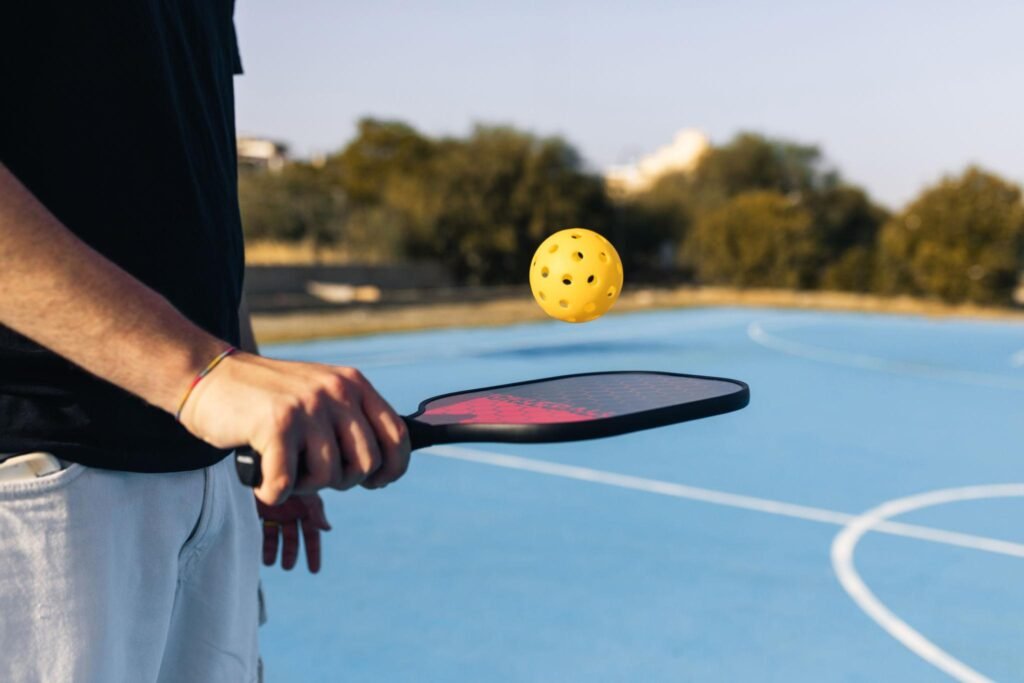
The paddle bounce challenge is one of the simplest pickleball exercises for beginners.
It helps you become familiar with how the ball responds to your paddle without needing a full court or a practice partner.
How to Do the Paddle Bounce Drill
- Hold your paddle comfortably in front of your body.
- Place a pickleball on the paddle face.
- Gently tap the ball upward.
- Try to keep each bounce at a manageable height.
- Count how many consecutive controlled taps you can complete.
Start with a goal of five taps.
Once that feels comfortable, aim for 10, then 20 consecutive touches.
Make It a Little More Challenging
Try alternating between the forehand and backhand sides of your paddle.
You can also practice changing the height of your taps while keeping the ball under control.
Common beginner mistake: Swinging too hard and sending the ball too high.
Beginner tip: Use small paddle movements and focus on making consistent contact.
2. Serve Accuracy Challenge: Build a Reliable Serve
Skill: Serve consistency and placement
Equipment: Paddle, balls, and a court
Players: Solo
Suggested practice: 5 minutes
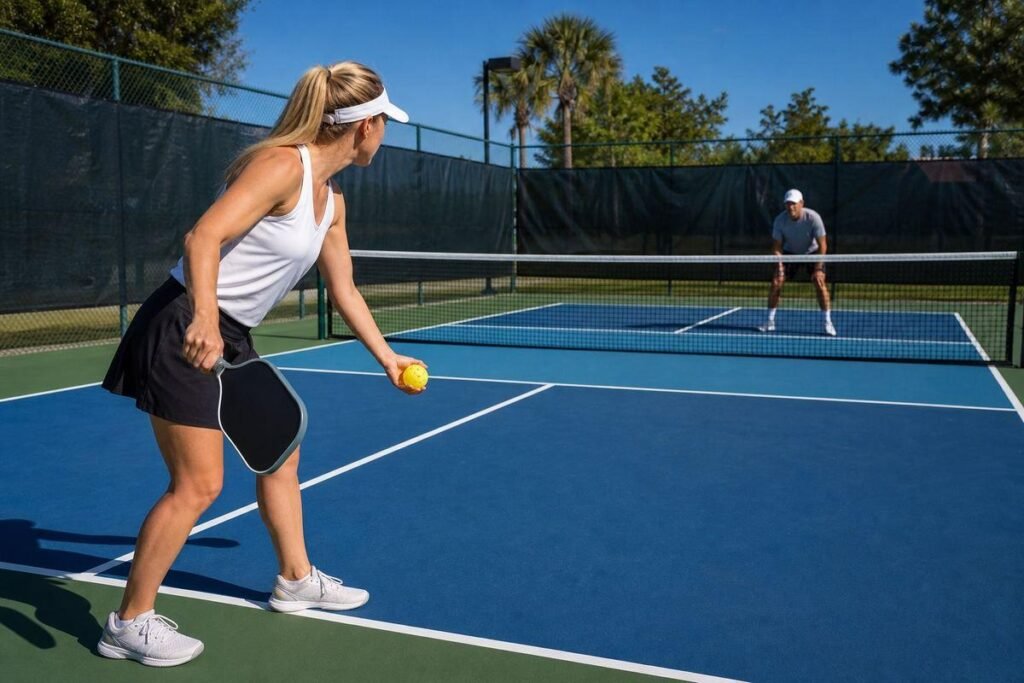
A reliable serve is one of the most useful skills a beginner can develop.
Rather than attempting a powerful serve, focus on placing the ball consistently into the correct service court.
How to Practice Your Serve
- Stand behind the baseline in the correct serving position.
- Choose a large target area inside the diagonally opposite service court.
- Use a legal underhand volley serve or drop serve.
- Hit 10 serves toward your chosen target.
- Record how many land legally inside the correct service court.
Remember that the serve must clear the kitchen, including its boundary line.
If you’re unsure about serving requirements, review the USA Pickleball Rules Summary.
Measure Your Progress
If six of your first 10 serves land legally in, record 6/10.
Repeat the drill during your next session and see whether your consistency improves.
Once you can serve reliably, try aiming deeper while still allowing a comfortable margin inside the lines.
Common beginner mistake: Trying to hit harder before developing consistent placement.
Beginner tip: A controlled serve that lands in is more valuable than a powerful serve that regularly goes out.
3. Deep Return Practice: Keep Your Opponent Back
Skill: Return accuracy and court positioning
Equipment: Paddles, balls, and a court
Players: Two
Suggested practice: 5 minutes
A good return of serve can give you time to move toward a more useful court position.
For beginners, the goal is to return the ball with enough height and depth to keep the rally manageable.
How to Practice Deep Returns
- Ask your partner to serve from the opposite baseline.
- Allow the serve to bounce before hitting your return.
- Aim your return toward a large target area in the deeper part of the opposite court.
- Concentrate on smooth contact rather than speed.
- Repeat for 10 returns, then switch roles.
Record how many returns land successfully inside the target area.
Why It Helps
A deeper return may make it more difficult for your opponent to move forward immediately.
It also gives you an opportunity to move toward the non-volley zone line when safe.
Common beginner mistake: Rushing forward before completing a balanced return.
Beginner tip: Make your return first, then move forward under control.
4. Five-Dink Rally: Develop Soft Touch
Skill: Dinking, patience, and ball control
Equipment: Paddles, ball, and net
Players: Two
Suggested practice: 5 minutes
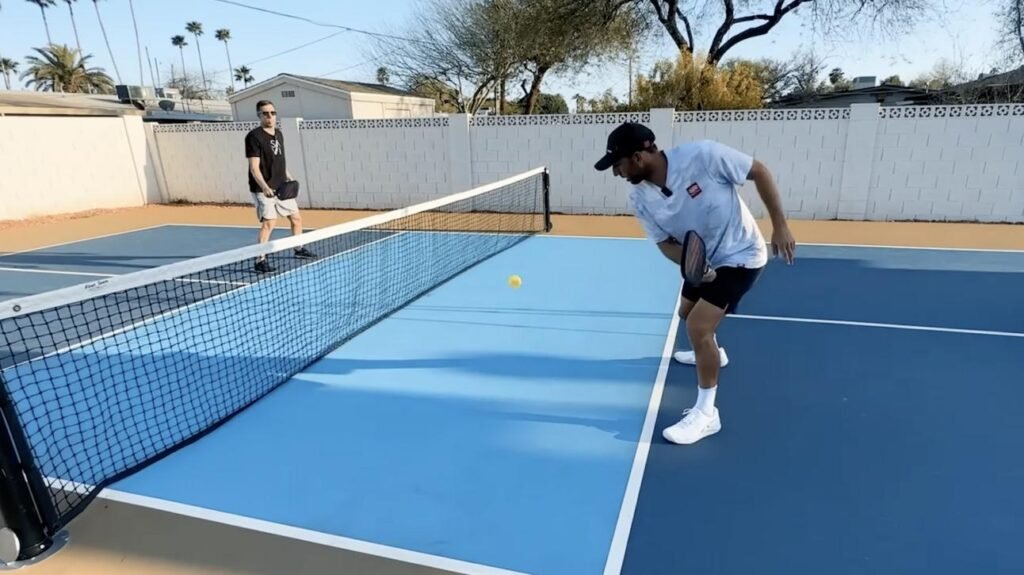
Dinking is an important skill in pickleball because it teaches control near the net.
A dink is a soft shot played after a bounce that generally lands in the opponent’s kitchen.
Unlike a power shot, a successful dink depends on touch and placement.
How to Practice Dinking
- Stand opposite your partner near the kitchen line.
- Gently exchange shots that clear the net and land in the opposite kitchen.
- Let the ball bounce before returning each shot.
- Keep your paddle movement short and controlled.
- Aim to complete five consecutive successful dinks.
Once you can complete five, increase your goal to 10 or 15.
Try a Crosscourt Dink
When you’re comfortable with straight-ahead dinks, try gentle crosscourt shots.
These require slightly different positioning and help you become familiar with angles.
Common beginner mistake: Swinging too aggressively and sending the ball too high.
Beginner tip: Keep your grip relaxed and focus on guiding the ball over the net rather than forcing it.
5. Kitchen-Line Footwork Drill: Improve Balance
Skill: Lateral movement and ready position
Equipment: Court shoes and a marked playing area
Players: Solo
Suggested practice: 3 minutes
Good pickleball footwork isn’t about running as fast as possible.
It’s about moving efficiently, maintaining balance, and preparing for the next shot.
This simple drill helps you practice side-to-side movement near the kitchen line.
How to Practice Footwork
- Stand just behind the non-volley zone line in a comfortable ready position.
- Bend your knees slightly.
- Take several small side steps to your right.
- Return toward the center.
- Repeat the movement to your left.
- Reset to your balanced ready position.
Start slowly and maintain control throughout the movement.
Add a Paddle
Once the steps feel comfortable, hold your paddle in front of your body.
Imagine preparing for a volley as you move.
Practice stopping under control before making a simulated shot.
Common beginner mistake: Crossing your feet unnecessarily during short lateral movements and losing balance.
Beginner tip: Keep your steps small and controlled. You don’t need to move quickly to practice good positioning.
6. Wall Rally Challenge: Practice Pickleball Alone
Skill: Paddle contact and reaction control
Equipment: Paddle, ball, and suitable practice wall
Players: Solo
Suggested practice: 5 minutes
Don’t have someone to practice with?
A wall rally can be a useful way to improve basic paddle control when a partner isn’t available.
Choose a safe, appropriate practice wall where ball strikes are permitted and won’t interfere with others.
How to Practice Wall Rallies
- Stand a comfortable distance from the wall.
- Choose a target area at a manageable height.
- Gently hit the ball toward the wall.
- Allow it to return and bounce when needed.
- Make another controlled shot.
- Count your successful consecutive returns.
Start with five controlled returns, then increase to 10.
Try Forehand and Backhand Shots
Once you’re comfortable with forehand returns, practice using your backhand.
You can alternate between the two strokes as your control improves.
Remember that a wall drill doesn’t reproduce every characteristic of a normal pickleball rally.
It’s mainly a useful exercise for repeated contact, coordination, and preparation.
Common beginner mistake: Standing too close to the wall or hitting too hard.
Beginner tip: Prioritize smooth contact and comfortable reaction time. Never practice where balls could endanger other people or damage property.
7. Third-Shot Drop Practice: Learn Controlled Placement
Skill: Soft shots from farther back in the court
Equipment: Paddles, balls, and net
Players: Two
Suggested practice: 4 minutes
The third-shot drop can seem difficult at first, but beginners can start learning the basic motion without attempting perfect shots immediately.
A drop shot is hit from farther back in the court and aims to land softly in the opponent’s kitchen.
Its purpose is to help create an opportunity to move forward without giving opponents an easy attacking shot.
How to Practice Your First Drop Shots
- Start several steps behind your kitchen line.
- Have your partner gently feed balls toward you.
- Use a controlled upward motion to send the ball over the net.
- Aim for the opponent’s kitchen.
- Repeat five to 10 times.
As your consistency improves, gradually move farther back.
Eventually, you can practice from near the baseline.
Focus on Height and Control
Your goal is to clear the net and have the ball land softly.
Don’t worry if the first few shots travel too high or too far.
Adjust your paddle movement gradually and pay attention to the ball’s trajectory.
Common beginner mistake: Attempting a difficult baseline drop before learning the basic soft-shot motion.
Beginner tip: Begin closer to the net and increase the distance as your confidence develops.
Your 30-Minute Beginner Pickleball Practice Routine
You don’t need an entire afternoon to practice useful pickleball skills.
This simple routine combines the seven drills with a short warm-up.
| Time | Activity | Main goal |
|---|---|---|
| 0–5 minutes | Warm-up | Prepare for movement |
| 5–8 minutes | Paddle bounce challenge | Ball control |
| 8–13 minutes | Serving accuracy | Consistent serves |
| 13–18 minutes | Deep return practice | Return placement |
| 18–23 minutes | Dink rally | Soft touch |
| 23–26 minutes | Kitchen-line footwork | Balance |
| 26–30 minutes | Wall rally or third-shot drop | Repeated contact or placement |
This is a flexible routine, not a requirement to complete every drill in one session.
With a partner, choose the third-shot drop for the final block. When practicing alone, choose the wall rally instead.
You can rotate between them on different days.
If you have extra time, complete the remaining drill after the main session.
How to Practice Pickleball Alone
If you can’t find a practice partner, you can still work on several important skills.
The best solo pickleball drills include:
- Paddle bounce practice.
- Serve accuracy challenges.
- Kitchen-line footwork.
- Safe wall-rally exercises.
- Controlled shadow swings without a ball.
A dedicated practice wall or an empty court with permission to practice can be useful.
Don’t worry about reproducing every game situation by yourself.
Use solo sessions to develop coordination and consistency, then practice live shots when a partner is available.
Track Your Pickleball Improvement
Recording a few simple numbers can make practice more meaningful.
You don’t need advanced statistics.
Start with a small progress table.
| Skill | Starting goal | Your result |
|---|---|---|
| Paddle control | 10 consecutive taps | ____ |
| Serving | 7 legal serves out of 10 | ____ |
| Deep returns | 6 accurate returns out of 10 | ____ |
| Dinking | 5 consecutive dinks | ____ |
| Wall rallies | 10 controlled returns | ____ |
| Drop shots | 5 successful drops out of 10 | ____ |
These are suggested practice targets, not official pickleball performance standards.
Try repeating the same challenges over several sessions.
You may notice that your accuracy improves even when your shots don’t feel dramatically different.
How Often Should Beginners Practice?
For many recreational beginners, two or three sessions each week can be a useful starting point.
However, the right frequency depends on your fitness, recovery, schedule, and access to a court.
Even short practice sessions can be helpful if you focus on one or two skills at a time.
Allow time for recovery, especially if you’re new to court sports or returning after a period of inactivity.
Five Common Pickleball Practice Mistakes to Avoid
1. Practicing Power Before Accuracy
Hitting harder isn’t always the solution.
Start with consistent contact and gradually add pace as your control develops.
2. Skipping the Warm-Up
Give your body time to prepare before practicing movement and repeated strokes.
3. Trying Too Many Skills at Once
Choose a clear goal for each session.
For example, focus on serving consistency one day and dinking accuracy during another.
4. Ignoring Footwork
Good shots often begin with balanced movement and positioning.
Include simple footwork practice alongside your paddle drills.
5. Never Measuring Progress
A basic record of successful serves, dinks, or rallies can help you recognize improvements.
Small gains matter.
Frequently Asked Questions About Pickleball Drills
What are the best pickleball drills for beginners?
Paddle control, serve accuracy, deep returns, and dinking drills are useful starting points.
These exercises focus on fundamental skills that beginners use regularly during games.
Can you practice pickleball by yourself?
Yes. Beginners can practice paddle taps, serving, footwork, and safe wall rallies without a partner.
Some skills, including live returns and realistic dinking exchanges, are easier to practice with another player.
How long should a beginner practice pickleball?
A focused practice session of approximately 20–30 minutes can be a manageable starting point for many players.
Adjust the duration to your experience, comfort, and physical condition.
How often should beginners practice pickleball?
Two or three sessions per week can provide regular opportunities to develop skills.
However, consistency, recovery, and enjoyment are more important than following a fixed schedule.
What should beginners practice first?
Start with paddle control and serving.
Once you’re comfortable making consistent contact, add returns, dinking, and simple court movement.
How do you improve your pickleball serve?
Choose a large target inside the correct service court and practice a repeatable, legal serving motion.
Measure how many serves land successfully before concentrating on more difficult placement.
What is the hardest pickleball shot for beginners?
Different players struggle with different shots.
Many newcomers find controlled drop shots challenging because they require a combination of touch, height, and placement.
Start closer to the net and gradually increase the distance.
Final Thoughts: Improve One Skill at a Time
Becoming a more confident pickleball player doesn’t require complicated training.
The most useful pickleball drills for beginners are simple exercises you can repeat consistently.
Start with paddle control, develop a reliable serve, practice your footwork, and gradually introduce softer shots such as dinks and drops.
You don’t need to master every skill immediately.
Focus on small improvements, celebrate longer rallies, and enjoy the process of learning.
Ready to make your next practice session easier? Explore our Shop the Gear page for beginner-friendly paddles, practice balls, and useful court accessories that can help you prepare for your next game.