Affiliate Disclosure: This article may contain affiliate links. If you purchase through these links, Pickleball Sport may earn a small commission at no additional cost to you. As an Amazon Associate, I earn from qualifying purchases.
Read our full Affiliate Disclosure.
You’re standing on the pickleball court, ready for your first doubles game. Someone calls out “0-0-2,” everyone moves into position, and you’re left wondering what those numbers actually mean.
If that sounds familiar, you’re not alone.
Pickleball is easy to start playing, but keeping score can feel confusing at first—especially when you add serving rotations, changing court positions, and the unusual three-number score call used in doubles.
The good news? Pickleball scoring explained in simple steps is much easier to understand than it first appears.
Once you learn who can score, when players switch sides, and why every doubles game starts at 0-0-2, you’ll be able to follow the game with more confidence.
This beginner-friendly guide walks you through traditional scoring, doubles and singles differences, serving order, and common mistakes. We’ll also explain the optional rally-scoring format recognized in the 2026 USA Pickleball rules.
Quick Takeaways: Pickleball Scoring Basics
- In traditional pickleball scoring, only the serving team or player can score points.
- Most recreational games are played to 11 points, and the winner must lead by at least two.
- In traditional doubles, the score is called using three numbers.
- Doubles games begin with the score 0-0-2.
- Serving teams switch positions after scoring a point.
- In singles, the score has only two numbers.
- Rally scoring is a different format where either side can earn a point by winning a rally.
1. How Does Pickleball Scoring Work?
Pickleball traditionally uses a system called side-out scoring.
Under this system, a team earns a point only when it wins a rally while serving.
If the receiving team wins the rally, it doesn’t earn a point. Instead, the serving turn advances or changes to the other team.
A Simple Example
Imagine Team A is serving with a score of 3-2.
If Team A wins the rally, its score increases to 4-2.
If Team B wins the rally, Team B doesn’t score. Depending on the current server, the serve either moves to Team A’s second server or passes to Team B.
This distinction is one of the most important parts of traditional pickleball scoring.
Beginner tip: Remember the phrase “Only the server scores” when playing traditional side-out scoring.
2. How Many Points Do You Need to Win?
Most recreational pickleball games are played to 11 points.
However, reaching 11 doesn’t automatically end the game. You must lead by at least two points.
Example Scores
| Score | Is the game over? | Why? |
|---|---|---|
| 11–7 | Yes | A team has at least 11 and leads by four |
| 11–9 | Yes | A team leads by two |
| 11–10 | No | The lead is only one point |
| 12–10 | Yes | A team leads by two |
| 14–13 | No | The lead is only one point |
Some tournament formats use games to 15 or 21 points, also typically requiring a two-point lead.
Always confirm the scoring format before starting a recreational match, league game, or tournament.

3. What Does 0-0-2 Mean in Pickleball?
One of the most frequently asked beginner questions is: “Why does pickleball start at 0-0-2?”
The answer comes from the traditional doubles serving system.
In doubles, each team normally has two server turns before the serve passes to the opponents.
However, the team that starts the game receives only one server turn during its first possession.
That’s why the opening score is called 0-0-2.
Understanding the Three Numbers
The doubles score follows this order:
Serving team’s score – Receiving team’s score – Server number
For example:
| Score call | Meaning |
|---|---|
| 0-0-2 | Both teams have zero points; the starting team is on its one-server opening turn |
| 3-2-1 | Serving team has three; receiving team has two; first server of this service turn |
| 5-4-2 | Serving team has five; receiving team has four; second server of this service turn |
| 8-8-1 | Both teams have eight; first server of the current service turn |
The third number identifies whether the player is Server 1 or Server 2 during that team’s current service turn.
It is not necessarily a permanent number assigned to that player for the entire match.
Beginner tip: Think “my score, your score, my server number.”
4. Why Does a Pickleball Game Start at 0-0-2?
The starting team receives only one server turn to reduce the advantage of serving first.
Although the player serving first is the team’s first person to serve, the opening score uses the number 2.
This tells everyone that when the initial server loses a rally, the serve passes immediately to the opposing team.
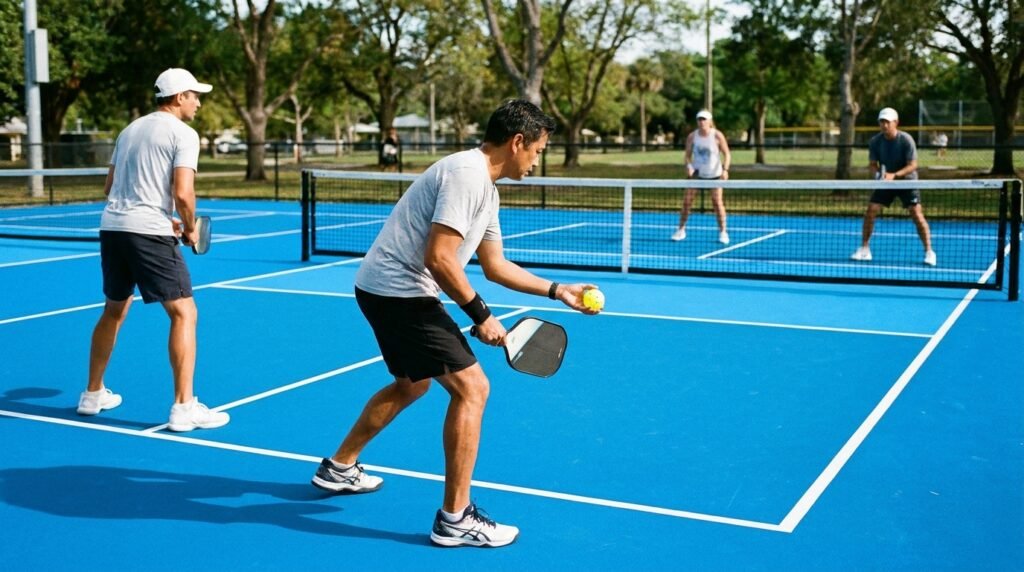
Starting a Doubles Game
- Both teams begin with zero points.
- The starting server stands on the right side.
- The starting score is called “0-0-2.”
- The server serves diagonally into the opposite service court.
- If the serving team wins the rally, it earns one point and the same player serves again from the other side.
- When the starting serving team loses a rally, the opponents receive the serve.
After this opening exception, both players on each team normally have an opportunity to serve before a side out.
This is why experienced players often remind beginners that the game starts with only one serving turn.
5. How Does Serving Rotation Work in Doubles?
Serving rotation is often the trickiest part of pickleball scoring for new players.
Once you understand the pattern, however, it’s easier to remember.
The Basic Serving Sequence
After a side out, the new serving team’s first server begins from the right-hand service court.
If that team scores, the same server switches to the opposite side and serves again.
The serving team continues switching positions after each point it earns.
When the first server loses a rally, the serve passes to their partner.
The second server serves from the appropriate position until that team loses another rally.
At that point, a side out occurs, and the opposing team receives the serve.
What Is a Side Out?
A side out happens when the serving opportunity passes from one team to the other.
The receiving team does not receive a point merely because it earns a side out under traditional scoring.
Example: The First Three Rallies
Suppose Team A serves first.
Rally 1: Team A wins.
Team A earns a point. The score becomes 1-0, and the same player serves again from the left side.
The score call is now 1-0-2.
Rally 2: Team B wins.
Team B receives the serve because Team A was on its special opening service turn. Team B hasn’t earned a point, so the score is still 1-0 in Team A’s favor.
When Team B prepares to serve, the score call becomes 0-1-1 because the serving team’s score is announced first.
Rally 3: Team B wins while serving.
Team B earns a point, tying the game at 1-1. Its first server switches sides and serves again.
The score call becomes 1-1-1.
Beginner tip: Always announce the serving team’s score first, even when the serve changes teams.
6. When Do Players Switch Sides in Pickleball?
Understanding player positions is another helpful way to keep the score straight.
In traditional doubles, the players on the serving team switch left and right after scoring a point.
The receiving team doesn’t switch service-court positions just because it wins a rally.
The Even and Odd Score Rule
A useful way to check positions is to remember which player started on the right side for each team.
When that team’s score is even, its starting player should be on the right.
When its score is odd, that starting player should be on the left.
| Team score | Starting player’s correct side |
|---|---|
| 0 | Right |
| 1 | Left |
| 2 | Right |
| 3 | Left |
| 4 | Right |
| 5 | Left |
This helps teams recognize positioning errors.
It does not mean both players should change sides every time any rally ends.
Remember This
The serving team’s positions change after scoring points.
The receiving team keeps its positions during the opponents’ service turn.
If you’re unsure who’s standing on the correct side, check your team’s score and identify the player who began the game on the right.
7. Pickleball Scoring Explained: How Does It Work?
Singles scoring is simpler because there is only one player on each side of the court.
Under traditional singles scoring, only the serving player can earn a point.
The score is called using two numbers instead of three:
Server’s score – Receiver’s score
There is no third server number because there is no partner who takes over the serve.
Where Does the Singles Server Stand?
The server’s own score determines the serving side.
- Even score: Serve from the right.
- Odd score: Serve from the left.
For example, if your score is 4, you serve from the right.
If your score is 5, you serve from the left.
The serve still travels diagonally to the opposite service court.
If the server loses the rally, the serve passes to the opponent.
Beginner tip: In singles, remember “Even right, odd left.”
8. Traditional Scoring vs. Rally Scoring
Although traditional side-out scoring is common, pickleball can also use rally scoring.
Under rally scoring, the player or team winning a rally earns a point regardless of who served.
That means the receiving team can score by winning a rally.
What’s the Difference?
| Feature | Traditional scoring | Rally scoring |
|---|---|---|
| Who earns points? | Serving player or team | Winner of each rally |
| Doubles score call | Three numbers | Two numbers under the 2026 provisional format |
| Doubles server turns | Normally two per team | One server per team per service possession |
| Starting score | 0-0-2 in doubles | 0-0 |
| Can a receiving team earn a point? | No | Yes |
USA Pickleball includes rally scoring as a provisional option in its 2026 rulebook.
The 2026 version permits a receiving team or player to earn the game-winning point by winning a rally, unlike a restriction that applied in the earlier provisional format.
Not every recreational group or tournament uses rally scoring, so check the format before playing.
For full details, consult the USA Pickleball Official Rules.
9. Five Common Pickleball Scoring Mistakes
Beginners frequently make small mistakes when learning to call the score and rotate servers.
Here are five to watch for.
Mistake 1: Calling the Receiving Team’s Score First
Always announce the serving team’s score first.
Mistake 2: Forgetting the Third Number in Doubles
Traditional doubles scoring includes the server number.
Remember: serving score, receiving score, server number.
Mistake 3: Assuming the Same Player Is Always Server 1
Server 1 and Server 2 refer to the current service turn, not permanent player identities.
Mistake 4: Switching Sides at the Wrong Time
Under traditional doubles scoring, teammates change positions after their team scores while serving—not after every rally.
Mistake 5: Forgetting the Opening Server Exception
The starting team gets only one server turn to begin the game.
That’s why the opening call is 0-0-2.
If you’re new to the sport, don’t worry about getting every situation right immediately. Call the score clearly and ask for help when needed.
Before heading to the court, make sure you have the essentials. Our Pickleball Gear for Beginners guide explains which paddles, balls, shoes, and accessories you need to get started.

10. A Simple Way to Practice Keeping Score
The easiest way to learn scoring is to rehearse it during short practice rallies.
Try this exercise with three other players.
- Start a traditional doubles game at 0-0-2.
- Before each serve, have the server announce the score.
- After every rally, identify whether a point was earned or the serve changes.
- Check whether the server is on the correct side.
- Continue until both teams have practiced several service turns.
For beginners, it can help to have someone record the score on paper during the first few games.
Quick Scoring Reminder
| Situation | What happens in traditional scoring? |
|---|---|
| Serving team wins rally | Serving team earns one point |
| First server loses rally | Second server takes over, except on the game’s opening service turn |
| Second server loses rally | Side out; opponents serve |
| Receiving team wins rally | No point; serve advances or changes |
| Serving team earns a point | Same server moves to the opposite service court |
| Team reaches 11 with a two-point lead | Team wins a standard 11-point game |
The more often you practice, the more natural the scoring sequence becomes.
For additional beginner exercises, explore our 7 Easy Pickleball Drills for Beginners guide.
Frequently Asked Questions About Pickleball Scoring
Why does pickleball start at 0-0-2?
Traditional doubles starts at 0-0-2 because the team serving first gets only one server turn during its opening possession.
The third number indicates that the serve will pass to the opponents when the starting server loses the rally.
Can you score points when you’re not serving?
Not under traditional side-out scoring.
However, under rally scoring, a point is earned by the winner of each rally, including the receiving side.
What does 3-2-1 mean in pickleball?
It means the serving team has three points, the receiving team has two points, and the player serving is Server 1 during the current service turn.
Do you have to win pickleball by two points?
Yes, standard games are played to a target score such as 11, and the winner must lead by two points.
A game tied at 10-10 continues until someone earns the required two-point margin.
How do you remember which side to serve from?
In singles, an even server score means serve from the right and an odd server score means serve from the left.
In doubles, serving positions depend on the team’s score, starting player, and current serving sequence.
Is pickleball scoring the same for singles and doubles?
Both formats can use traditional side-out scoring.
However, doubles uses three-number score calls and partner serving turns. Singles uses two-number score calls with only one server per side.
Does pickleball use rally scoring in 2026?
Yes. The 2026 USA Pickleball rulebook includes rally scoring as a provisional option, with specific rules and tournament-format restrictions.
Traditional scoring is still widely used.
Final Thoughts: Pickleball Scoring Gets Easier With Practice
Pickleball scoring can feel confusing during your first few games, but it becomes easier once you understand the basic pattern.
Remember three important rules: only the serving side scores in traditional play, doubles uses a three-number score call, and the opening doubles score is 0-0-2.
From there, practice serving rotation, watch when players switch positions, and announce the score before every serve.
Don’t worry if you need reminders at first. Even experienced players occasionally stop to confirm the correct score.
With a little repetition, keeping score will become another natural part of enjoying the game.
Getting ready for your next match? Visit our Shop the Gear page for beginner-friendly paddles, pickleballs, and practical court accessories to help you play comfortably and confidently.